
How to use a thermocouple for accurate temperature measurement
You can use a thermocouple to measure temperature well. Temperature Sensors - Thermocouples give you good results in many cases. Follow each step carefully. This helps you not make mistakes. You will get the best readings if you do this.
Tip: If you handle your sensor gently, you get better results.
Thermocouple Selection and Setup
Image Source: unsplash
Choosing the Right Thermocouple Type
You have to pick the right thermocouple for your job. Think about where you will use it. Some thermocouples work better in hot places. Others are good for cold spots. Type K can measure very cold and very hot temperatures. That is why people use it in factories and labs. Type J is good for making plastic and for vacuum work. Type T is best for very cold things and food checks. It works well for low temperatures. Type E is used a lot in chemical plants.
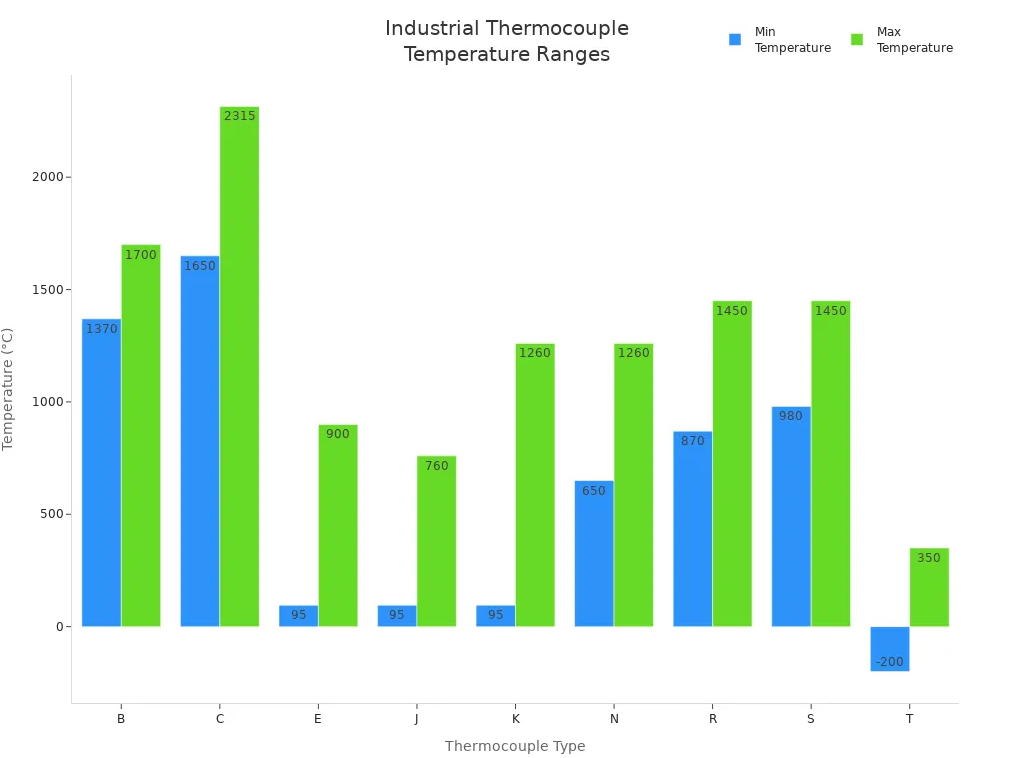
Check the temperature range before you choose a thermocouple. Some, like B and C, are for very hot jobs like steel or glass making. Others, like T, are better for cold storage or food safety. You should also think about how fast you need it to react. Thin ribbon thermocouples react faster than thick ones.
Sensitivity is important too. Type T lets heat move faster than Type K. But it can make more mistakes. Type K is not as sensitive but gives steady readings. If you want very good accuracy, use special wires and do not use old sensors. Always match the thermocouple to your job. You may need it to last long, react fast, or resist chemicals.
Tip: Always look at the color code on the wires. This helps you pick the right thermocouple and avoid mistakes.
Proper Installation Steps
You need to install your thermocouple the right way. This helps you get good readings. For air temperature, do these steps:
1、Get all the parts you need.
2、Make sure everything fits together.
3、Remove any danger from pressure or electricity.
4、Follow the guide for best results.
For surface temperature, use these tips:
Put the wires so they leave the sensor where the temperature stays the same. This stops heat from moving along the wires and causing mistakes.
Run the wires away from the sensor for a short way. This keeps extra heat from changing your readings.
Use ribbon thermocouples if you want quick results and less delay.
Keep wires from different sensors apart so they do not mess each other up.
Things around your sensor can change how it works. High humidity can make water collect on the sensor. This can cause mistakes. Over time, water can rust the sensor and make it less accurate. Vibration can also hurt the sensor. Tie the wires down and do not put them where things shake a lot.
When you put in the sensor, get the tip ready by taking off the insulation and twisting the wires. Cover the bare wires with heat shrink tubing. Hold the cable with zip ties or tape, but do not make them too tight. Support the cable so it does not move. Do not bend it sharply and keep the tip in the right place.
Note: Always follow the maker’s instructions for putting it in. This helps you avoid mistakes and keeps your sensor working well.
You also need to think about the reference-junction measurement. The thermocouple checks the difference between the hot and cold ends. If you do not measure the cold end right, your readings will be wrong. Cold junction compensation is very important for good results.
Alert: Only use thermocouple extension cables, not regular copper wires. This stops mistakes in your readings.
If you do all these steps, your thermocouple will give you good and steady temperature readings.
Connecting to Measurement Devices
You must connect your thermocouple to a meter or data logger. Always check which wire goes where before you connect. If you switch the wires, your readings will be wrong. Many people make mistakes by mixing up wires or using copper wire instead of thermocouple extension wire. Only use wires made from the same stuff as your sensor.
1、Make sure connections are tight and clean.
2、Use special terminal blocks for thermocouples to stop extra voltage.
3、Check that connectors fit well and do not wiggle.
4、Follow the maker’s instructions for tightening and cleaning.
You can hook up more than one thermocouple in different ways. If you connect them in a series, you make the sensor more sensitive. If you connect them in parallel, you get an average from all sensors. Pick the way that works best for your job.
Tip: Check the probe and connectors often for damage or dirt. Clean them so your readings stay steady.
Calibration and Reference-Junction Compensation
You need to calibrate your thermocouple to get good results. Calibration means testing the sensor at different temperatures and writing down the readings. Start by setting the temperature source, wait for it to settle, and record the value. Do this for every temperature you want to check. Most labs use tolerance testing because it works well for sensors that change over time.
Test the sensor at every temperature you need.
Wait for the sensor to settle at each point.
Use tolerance testing or characterization if needed.
Modern devices use cold junction compensation to fix mistakes. The system checks the temperature at the reference junction and changes the readings. Devices like thermistors or RTDs sense the temperature near the reference point. The instrument uses special tables to find the real temperature at the hot end. This keeps your measurements right, even if the room changes.
Note: Calibration mistakes can cause big problems. Even small errors can change your readings and mess up your product. Calibrate often to stop drift and keep your system safe.
Signal Conditioning for Accuracy
Thermocouples make very small voltages. You need to make these signals bigger to use them. Use good amplifiers to boost the voltage. This makes the signal strong enough for your meter or data logger.
Use shielded cables to block noise from other things.
Pick twisted pair wires to stop unwanted signals.
Add ground planes in your circuit to lower interference.
Signal conditioning also means making the output match the real temperature. Thermocouples do not always give a straight line response. Linearization helps fix this. Cold junction compensation is another important step. It fixes mistakes from the connection between the sensor and the device.
Alert: Good signal conditioning makes your readings better and keeps them steady, even in busy places.
Troubleshooting Common Thermocouple Issues
Sometimes your thermocouple gives readings that jump around or are wrong. You can fix most problems by doing a few things.
1、Look for ground loops. Use differential inputs and add a resistor from the negative input to ground. Put the sensor in with insulating materials.
2、Cut down noise. Check the range and resolution settings on your device. Unplug the sensor and test the noise by connecting the input to ground.
3、Remove outside problems. Unplug all other connections except one sensor. Test in different spots to find the issue.
4、Check temperature readings. Make sure cold junction compensation is set up right. Compare the raw voltage to what you expect.
Mistakes happen if you use the wrong sensor type, mix up the wires, or pick the wrong extension wire. Changes in the alloy and sensor age can also hurt accuracy. Problems at the reference junction and ground loops are common. Check and calibrate often to stop these issues.
Tip: Plan regular calibration and check your sensor often. Fix problems fast to avoid big failures.
You can measure temperature well if you do these things:
1、Check and adjust your thermocouple often.
2、Look for damage and clean the wires.
3、Test your sensor with a heat source you know.
4、Take care of your sensor all the time.
Doing these steps helps you make fewer mistakes. It also keeps things safe and helps you work better. Good measurements help you follow rules and make customers happy.
FAQ
How often should you calibrate your thermocouple?
You need to check your thermocouple at least once every year. If you use it in tough places, check it more times.
Can you use regular wire to extend a thermocouple?
Always use thermocouple extension wire. Regular wire can change the signal and make your temperature readings wrong.
What causes a thermocouple to give unstable readings?
Loose wires, electrical noise, or broken wires can make readings jump around. Look at your setup and clean the contacts to fix most problems.