
Counterfeit Electronic Components: How to Spot Them
Counterfeit parts are getting harder to spot, easier to find, and more expensive to deal with once they're in your product. Here's how to catch them early.
There's a batch of microcontrollers sitting in a warehouse somewhere right now. They're in the right packaging. The markings look correct. The date codes are plausible. They'll probably pass a casual incoming inspection.
They're also fake.
Maybe they're remarked parts — chips from a lower-spec grade that have been sanded and reprinted to look like the premium version. Maybe they're salvaged components pulled off scrapped boards, cleaned up, and repackaged. Maybe they're functional but so far out of spec that they'll work fine in a test environment and start failing six months after your product ships.
The counterfeit component problem in electronics is not small. Industry estimates put the annual value of counterfeit parts moving through global supply chains in the billions of dollars. The problem gets worse during supply crunches — when lead times are long and buyers are under pressure to keep production running, shortcuts happen, and counterfeiters know it.
If you're sourcing from non-authorized channels, or if you're buying from distributors you haven't properly vetted, you have exposure here. The question isn't whether counterfeit parts are in the market. They are. The question is whether your processes are set up to catch them.
My other article fully explains the basic definitions of genuine, refurbished, and counterfeit chips.
Why Counterfeiting Is Harder to Detect Than It Used to Be
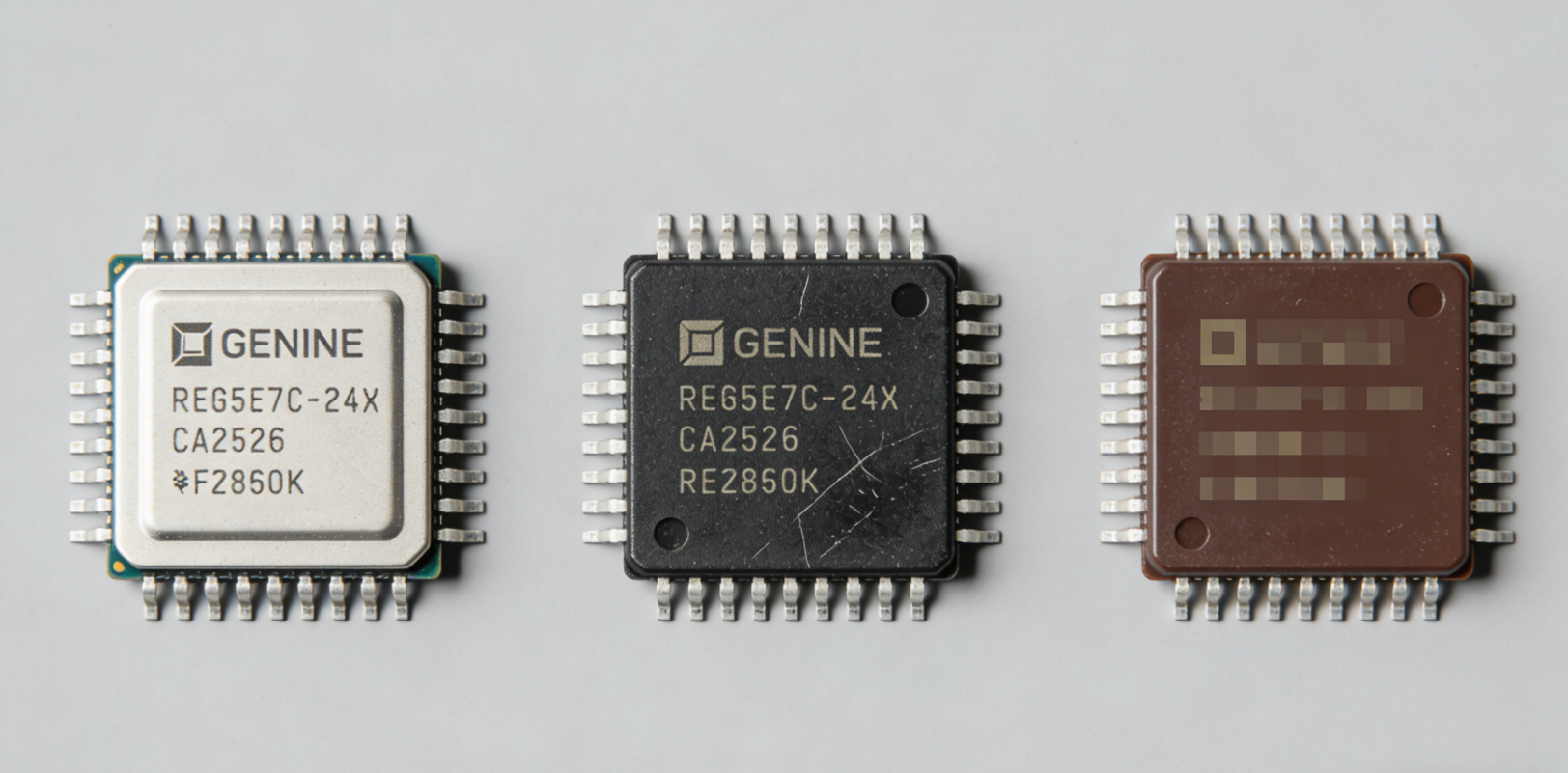
Ten years ago, catching a counterfeit chip wasn't always difficult. Obvious packaging differences, wrong fonts on labels, markings that smudged when you touched them — the tells were often visible. That's less true now.
The people producing counterfeit electronics have gotten more sophisticated. They have access to the same packaging materials, the same label printing equipment, and in some cases, access to genuine parts from which they can copy every detail of the authentic article. The result is parts that, on visual inspection alone, are essentially indistinguishable from the real thing.
At the same time, the volume of parts moving through secondary markets has grown. More brokers, more online platforms, more cross-border trade — all of it creates more opportunities for counterfeit parts to enter the supply chain at a point where traceability gets murky.
The most dangerous counterfeit parts are the ones that work. A component that fails immediately gets caught quickly. A component that passes initial testing but degrades over time can make it into finished products, into customer hands, and into warranty claims before anyone connects the dots back to a sourcing problem.
The Types of Counterfeit Parts You'll Actually Encounter
Not all counterfeit components are the same. Understanding the categories helps you target your detection efforts in the right places.
Remarked parts. A genuine chip, but not the one on the label. The marking is sanded off and replaced with a higher-spec or higher-value part number. The chip works — it just doesn't do what you paid for. Common with MCUs, memory, and analog ICs where the same die is sold at multiple spec levels.
Salvaged components. Parts pulled off end-of-life circuit boards, cleaned, re-tinned, and repackaged. They may have residual solder, damaged leads, or contamination from prior use. They can pass visual inspection and some functional tests while having significantly shortened lifespans or latent defects.
Out-of-spec parts. Chips that failed quality control at the manufacturer level — rejected for not meeting spec — that enter the market through gray channels. They may function at room temperature and normal conditions while failing under load, temperature extremes, or over time.
Cloned parts. Physically similar but manufactured by an unauthorized entity. Most common with passive components and simple ICs. Often indistinguishable visually from genuine parts.
Overproduction / excess. Parts manufactured beyond the authorized quantity, sold outside normal channels. These may actually be genuine chips, but they lack proper traceability documentation and may have storage or handling history that's unknown.
Related: Why Certain Chips Are Always Out of Stock — And How to Source Them Without Overpaying — Supply crunches create the conditions where counterfeit parts thrive. Understanding shortage dynamics helps you source more safely.
Visual Inspection: What to Actually Look For
Visual inspection isn't enough on its own to catch sophisticated counterfeits. But it catches a lot of obvious problems, and it costs nothing. Every incoming component lot should go through it.
Markings consistency. Compare the font, size, and position of markings against a known-good reference sample or the manufacturer's product documentation. Counterfeits often have subtle differences in font weight, character spacing, or logo proportions.
Surface texture. Look at the package surface under magnification. Sanding or re-marking leaves traces — slight roughness, uneven texture, or residual marking under the new print. Authentic parts have a consistent, clean surface.
Lead condition. Leads should be uniform in color, finish, and shape. Mixed lead finishes (some oxidized, some bright), uneven coplanarity, or solder residue are signs of salvaged parts. New parts should not have any sign of prior use.
Date code and lot code consistency. Within a single reel or batch, all parts should have the same date code. Mixed date codes on what was sold as a single lot is a red flag.
Packaging integrity. Authentic parts from distributors come in factory-sealed packaging with proper moisture-sensitive level (MSL) indicators. Repackaged parts often have slight inconsistencies in the bag sealing, label placement, or desiccant presentation.
Testing: Beyond What Your Eyes Can Tell You
For anything going into a critical product — or any purchase from an unfamiliar source — visual inspection should be followed by physical and electrical testing.
Solderability testing. Verifies that leads will solder correctly in production. Salvaged parts frequently have compromised surface finishes that cause poor wetting. This is a cheap, fast test that catches a common counterfeit category.
X-ray inspection. Reveals internal die structure. If the internal layout doesn't match what should be inside the package, you've found a problem. X-ray is especially valuable for BGAs and other packages where the die isn't visible.
Electrical parameter testing. Functional testing against datasheet specifications. Not just "does it turn on" but does it meet the full parametric spec across the operating range — voltage thresholds, timing, current consumption, temperature behavior.
Decapsulation. For high-value or high-risk purchases, decapping a sample and examining the die directly is the definitive test. It's destructive, but it catches remarked parts and clones definitively.
You don't need to run every test on every purchase. The level of testing should match the risk level: new supplier, constrained component, critical application, or unusually low price are all triggers for a more thorough inspection protocol.
How to Vet a Distributor Before You Buy
Most counterfeit component problems don't start with a bad purchase decision by someone who knew better. They start with inadequate supplier qualification. Before you place a meaningful order with a distributor you haven't worked with, here's the minimum you should verify.
Can they provide a full chain of custody — a paper trail from the original manufacturer to their warehouse?
Are they an authorized distributor for the manufacturer in question, or an independent? Both can be legitimate, but the documentation requirements differ.
Do they carry ERAI membership or AS6081 certification? These aren't perfect guarantees, but they indicate the supplier has made a commitment to counterfeit avoidance practices.
What is their incoming inspection process for the parts they stock?
Will they provide a Certificate of Conformance and manufacturer test reports?
Can you find verifiable references from other buyers in your industry?
A distributor who balks at any of these questions is giving you information. A good distributor who has nothing to hide will answer all of them without hesitation — because they've heard every one of these questions before and they have good answers.
Related: US Chip Export Controls Explained: What Every Electronics Procurement Manager Needs to Understand — Trade restrictions affect which channels components can legally move through — and why provenance documentation matters more than ever.
What to Do If You Suspect You've Received Counterfeit Parts
If incoming inspection raises concerns, stop. Don't put the parts into production while you're still investigating. The cost of a production hold is recoverable. The cost of counterfeit parts making it into finished products is not.
Report suspected counterfeits to ERAI. They maintain an industry database of counterfeit and suspect components that helps other buyers avoid the same problem. Reporting is confidential and contributes to an industry-wide early warning system.
If you're dealing with a significant quantity or a critical application, consider retaining a qualified third-party testing lab to do a full counterfeit investigation. The report can support any legal or commercial action against the supplier, and it documents that you took appropriate steps when the concern arose.
Document everything: the purchase order, the shipping documentation, the incoming inspection findings, and every communication with the supplier. If this ends up in a dispute — or if a defect later surfaces in the field — that paper trail is what protects you.
Building a Counterfeit Prevention Program
Reactive counterfeit management — catching bad parts when they arrive — is better than nothing. But it's not a sustainable approach for a procurement organization that's buying at scale.
A proactive counterfeit prevention program looks like this: qualified supplier list with documented vetting criteria, standard incoming inspection protocols that match testing level to risk level, clear internal procedures for handling suspect parts, and regular review of ERAI alerts and industry bulletins about known counterfeit issues.
None of this requires a dedicated quality team. It requires documented procedures, assigned responsibility, and consistent execution. For most procurement organizations, the investment in prevention is a fraction of the cost of a single significant counterfeit event.