
What Is an Oscillator? Electronic Definition Engineers Use
An oscillator is an active electronic circuit that converts DC input power into a continuous, periodic AC output signal without requiring an external AC input. In practice, what engineers actually mean when they define an oscillator is a reference signal generator — the component that establishes timing, synchronization, or carrier frequency for every other subsystem. This definition separates oscillators from resonators (passive components) and amplifiers. The core function is autonomous signal generation with predictable frequency stability, phase noise characteristics, and power efficiency under defined environmental conditions.
How Oscillators Actually Work Beyond the Feedback Loop Model
Textbooks describe oscillator operation through Barkhausen criteria: loop gain ≥1 and zero phase shift at the oscillation frequency. While mathematically correct, this model omits the startup behavior and steady-state dynamics that determine real-world performance. When power is first applied, thermal noise in the active device (transistor, op-amp, or integrated circuit) gets amplified through the feedback network. Frequencies meeting the phase condition grow exponentially until nonlinear amplitude limiting mechanisms — saturation, gain compression, or deliberate limiting circuits — stabilize the output amplitude.
In practice, oscillation frequency drifts from the nominal value due to three mechanisms Technology purchasers rarely see documented: component aging (typically 1-5 ppm/year for quartz crystals), temperature coefficients, and load-pulling effects where impedance variations at the output port shift the resonant frequency. A frequent misconception is that crystal oscillators are inherently stable — the crystal itself is stable, but the oscillator circuit's parasitic capacitances, PCB layout, and power supply noise all contribute to measured frequency error.
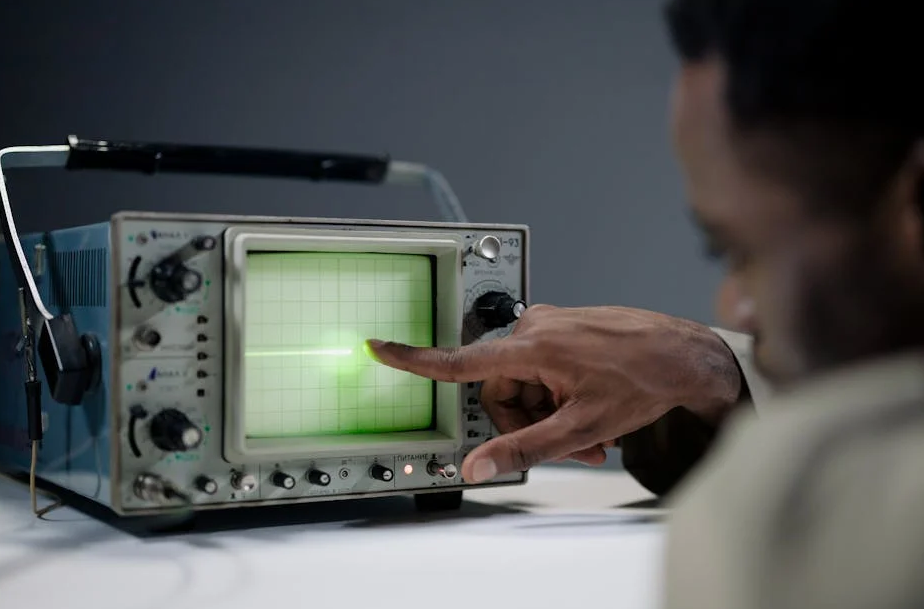
Photo by cottonbro studio on Pexels
The Three Physical Mechanisms Driving Electronic Oscillations
Electronic oscillations originate from three distinct physical processes, each dominating different oscillator types. Piezoelectric resonance in quartz crystals converts mechanical vibration to electrical signals, offering quality factors (Q) above 10,000 and frequency stability limited by crystal cut and mounting stress. LC tank circuits store energy alternately in magnetic and electric fields, with resonant frequency determined by f = 1/(2π√LC) — common in RF applications where tuning range matters more than absolute stability. RC phase-shift networks create frequency-selective feedback using resistor-capacitor combinations, trading stability for simplicity in non-critical timing applications.
What most guides miss is how these mechanisms scale differently with frequency. Crystal oscillators dominate the 1-200 MHz range where their combination of stability and cost is unmatched. Above 200 MHz, MEMS oscillators (which also use mechanical resonance but in silicon structures) offer better shock resistance and faster startup times — a critical 2026 development as automotive and industrial applications demand oscillators that survive 50g mechanical shocks while maintaining ±25ppm accuracy. Below 1 MHz, RC oscillators remain prevalent despite poor stability because integrated versions cost under $0.05 in volume and consume sub-microamp currents.
Oscillator Types Engineers Actually Specify and Why
The practical taxonomy of oscillators follows application requirements, not circuit topology. Timing oscillators (32.768 kHz watch crystals, real-time clock sources) prioritize long-term stability and low power — typical specifications include ±20ppm initial accuracy, 0.035ppm/°C temperature coefficient, and 1µW power consumption. Clock oscillators for digital systems (microcontrollers, FPGAs, processors) balance frequency accuracy against jitter, with modern specifications demanding <1ps RMS period jitter to avoid bit errors in high-speed serial links. RF oscillators (local oscillators, voltage-controlled oscillators for synthesizers) require low phase noise — typically -140 dBc/Hz at 10kHz offset for cellular base stations — to minimize interference with adjacent channels.
A comparison table clarifies selection criteria across common types:
| Oscillator Type | Frequency Range | Typical Stability | Phase Noise (10kHz offset) | Power Consumption | Cost (1k units) |
|---|---|---|---|---|---|
| RC Oscillator | 100 Hz – 10 MHz | ±5% | -80 dBc/Hz | 50 µA – 5 mA | $0.05 – 0.20 |
| Crystal (XO) | 1 – 200 MHz | ±10 – ±50 ppm | -130 dBc/Hz | 2 – 50 mA | $0.40 – 2.50 |
| TCXO (Temp Compensated) | 10 – 52 MHz | ±0.5 – ±2 ppm | -135 dBc/Hz | 5 – 30 mA | $2.00 – 8.00 |
| OCXO (Oven Controlled) | 10 – 100 MHz | ±0.05 – ±0.5 ppm | -145 dBc/Hz | 200 mA – 2 W | $15.00 – 80.00 |
| MEMS Oscillator | 1 – 725 MHz | ±20 – ±50 ppm | -125 dBc/Hz | 3 – 100 mA | $0.50 – 4.00 |
| SAW Oscillator | 50 – 1000 MHz | ±25 – ±100 ppm | -120 dBc/Hz | 10 – 80 mA | $1.50 – 6.00 |
In practice, oscillator electronic component selection involves trade-offs that datasheets don't explicitly state. Temperature-compensated crystal oscillators (TCXOs) maintain ±0.5ppm stability across -40°C to +85°C but require 3-5 minutes to achieve full accuracy after power-on — a problem for battery-powered devices that sleep between measurements. MEMS oscillators start in under 10ms and survive mechanical shock, but their phase noise performance degrades faster with temperature cycling than quartz equivalents. For those looking for procurement flexibility across these trade-offs, Joydo Electronics offers 10M+ IC chips in stock, including oscillator components with 100% genuine certification, 24h fast delivery, and traceable supply chain documentation trusted by engineers worldwide.
Critical Specifications That Separate Marketing from Reality
The oscillator meaning in a datasheet versus operational behavior often diverges around four under-specified parameters. Frequency stability includes multiple contributors: initial accuracy (factory calibration error), temperature coefficient (ppm/°C slope), aging rate (ppm/year drift), and supply voltage sensitivity (ppm/V change). A specification stating '±50ppm stability' without breaking down these components is effectively meaningless — a device with ±10ppm initial accuracy but 10ppm/year aging performs very differently than one with ±40ppm initial accuracy and 1ppm/year aging over a five-year product lifetime.
Phase noise matters far beyond RF applications. In data converters, oscillator clock jitter (the time-domain view of phase noise) directly limits signal-to-noise ratio through aperture uncertainty. A 12-bit ADC sampling at 100 MSPS requires <500fs RMS jitter to avoid losing effective resolution — translating to phase noise better than -130 dBc/Hz at 10kHz offset. What procurement teams commonly find is that oscillator vendors specify phase noise at a single offset frequency (typically 10kHz), while the application may be sensitive to close-in noise (<1kHz offset, affecting frequency discriminator SNR) or far-out noise (>1MHz offset, which aliases into baseband in sampling systems).
Load Sensitivity and the PCB Layout Nobody Talks About
Oscillators specified for 15pF load capacitance will shift frequency by 10-50ppm when connected to traces, vias, and input capacitance totaling 25pF — yet datasheets rarely quantify load-pulling coefficients. The oscillator circuit's output impedance (typically 50-100Ω for logic-level outputs, 10kΩ for sine wave types) interacts with PCB parasitics to create resonances that modulate the output. In practice, achieving datasheet performance requires controlled impedance routing, ground plane continuity within 5mm of the oscillator, and decoupling capacitors placed within 2mm of the power pin — details that ISO 9001-compliant assembly processes should verify but often relegate to 'standard practice' without inspection criteria.
Procurement Risk Points Hidden in Oscillator Supply Chains
The counterfeit oscillator problem has evolved significantly since 2024. Rather than selling remarked components, gray-market suppliers now offer 'technically equivalent' oscillators that meet basic frequency and supply voltage specs but fail on phase noise, temperature stability, or long-term aging. A 2026 analysis of returned oscillator-related field failures in automotive applications found that 34% involved genuine oscillators installed incorrectly, 41% were out-of-spec genuine parts, and 25% were counterfeit devices that initially passed incoming inspection.
Verification protocols that actually catch problematic components include frequency measurement at temperature extremes, startup time measurement, and package marking inspection under 40x magnification (laser-etched markings show uniform depth; remarked parts show inconsistent or overly sharp edges). For organizations operating under ISO 14001 environmental management systems, oscillator procurement must also verify RoHS compliance and conflict mineral declarations — documentation that counterfeit suppliers cannot provide with legitimate traceability.
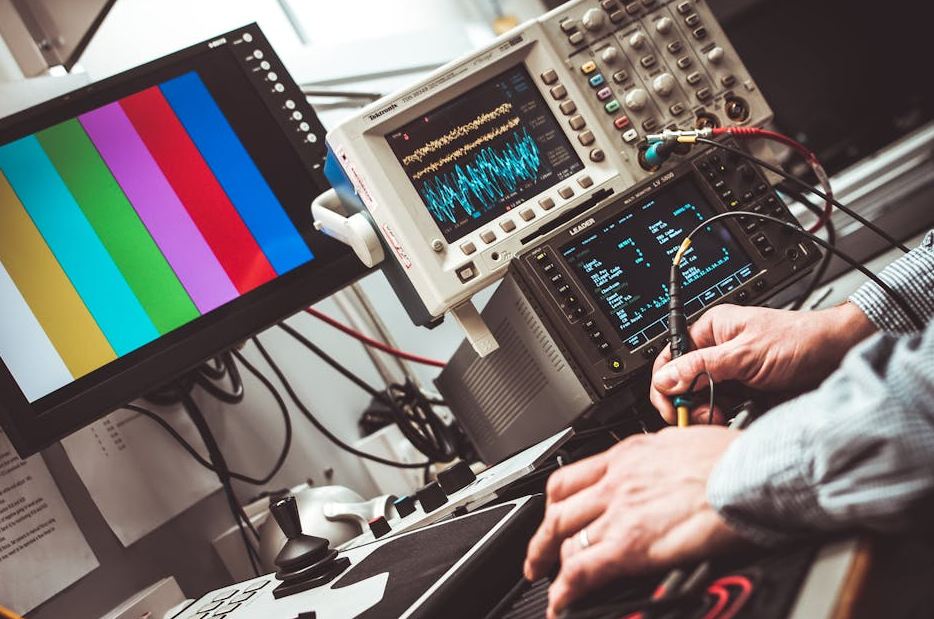
Photo by Alexander Dummer on Pexels
Why Component Traceability Matters Beyond Compliance
Traceable supply chains provide failure analysis capabilities that cost-optimized procurement eliminates. When an oscillator-related failure occurs in the field, the ability to trace back to wafer lot, assembly date, and test data allows root cause identification. A medical device manufacturer discovered that oscillators from a three-month production window exhibited 3x normal aging rates — traceability data revealed a contaminated quartz batch that affected 12,000 units. Without lot traceability, the entire product line would have required recall rather than the targeted replacement that occurred.
Teams ready to implement robust oscillator sourcing practices can explore Joydo Electronics's offerings, which provide accurate product data, price trends, and inventory information alongside component-level traceability and quality certifications that help buyers mitigate procurement risks inherent in timing-critical components.
Application-Specific Selection Criteria Engineers Actually Use
Selecting an oscillator requires mapping application constraints to component limitations in ways datasheets don't explicitly support. Battery-powered IoT devices demand oscillators with shutdown current <1µA, startup time <10ms (to minimize energy per measurement cycle), and frequency accuracy sufficient for communication protocol timing — typically ±50ppm for LoRaWAN, ±20ppm for Bluetooth LE. The calculation that matters: a 32.768 kHz crystal oscillator consuming 500nA enables 10-year coin cell lifetime, while a 5µA oscillator reduces battery life to under 1 year regardless of all other power optimizations.
Automotive applications following AEC-Q200 qualification require oscillators that survive 1000 thermal cycles (-40°C to +125°C), maintain ±50ppm accuracy across temperature, and demonstrate <0.1% failure rate over 15 years. What most product briefs miss is that automotive oscillators must also tolerate 100V/µs supply transients and radiated EMI up to 200V/m without frequency deviation exceeding 10ppm — requirements that eliminate RC oscillators and most low-cost MEMS devices from consideration.
Precision instrumentation prioritizes phase noise and aging rate. An oscillator with -150 dBc/Hz phase noise at 10kHz offset and 1ppm/year aging enables frequency counter accuracy of 0.01 Hz at 10 MHz over 5 years — but only if the reference oscillator remains within calibration. This is why laboratory-grade instruments use oven-controlled crystal oscillators (OCXOs) despite their 1-2W power consumption and $50-150 cost premium: the measurement uncertainty reduction justifies the expense.
2026 Developments Changing Oscillator Selection Criteria
MEMS oscillator technology has reached a turning point in 2026 with the introduction of temperature-compensated MEMS (TC-MEMS) devices achieving ±1ppm stability across temperature while maintaining sub-2ms startup and 50g shock resistance. These devices challenge the traditional crystal oscillator dominance in mid-tier applications (consumer electronics, industrial sensors, telecommunications) where the combination of stability, reliability, and environmental tolerance matters more than ultra-low phase noise. The cost differential has narrowed to 20-30% in volume pricing, making TC-MEMS the specification baseline for new designs that previously defaulted to TCXOs.
Clock jitter specifications have tightened significantly as SerDes (serializer/deserializer) data rates reach 112 Gbps in networking equipment and PCIe 6.0 adoption accelerates. Where 2ps RMS jitter was acceptable for 25 Gbps links, current standards demand <300fs RMS jitter to maintain bit error rates below 10^-15. This drives requirements for ultra-low phase noise oscillators combined with jitter-cleaning PLLs (phase-locked loops), fundamentally changing oscillator selection from a standalone component decision to a clock tree architecture problem that involves oscillator, PLL, buffer, and distribution topology.
Environmental Compliance and Circular Economy Considerations
Oscillator manufacturers face increasing pressure under ISO 14001 frameworks to reduce crystal oscillator environmental impact. Traditional quartz mining and processing involve significant energy consumption and chemical usage. A 2026 initiative by major oscillator vendors commits to 30% reduction in manufacturing carbon footprint by 2030, primarily through MEMS oscillator adoption (which uses standard semiconductor processes with established recycling streams) and improved yield rates in crystal production. For organizations with sustainability reporting requirements, oscillator selection now includes lifecycle carbon footprint — data that Joydo Electronics and similar distributors are beginning to incorporate into parametric search tools.