
Stabilised Power Supply Thermal Management & Reliability Tests
Most dc power supply qualification protocols test thermal performance at fixed ambient temperatures — typically 25°C, 50°C, and 70°C steady-state conditions. This approach captures thermal design margin but misses the cumulative damage from repeated expansion and contraction cycles. In practice, industrial equipment experiences hundreds of thermal transitions annually: facility HVAC cycling, seasonal temperature swings, and load-dependent self-heating.
A frequent misconception is that thermal cycling primarily stresses mechanical interfaces. In reality, semiconductor junction temperature swing rates create the highest failure acceleration factors. When a dc power source transitions from idle to full load in under 100 milliseconds — common in motor drive and robotics applications — junction temperatures can swing 60°C in seconds. This thermal shock propagates through die attach layers, wire bonds, and package mold compounds at different expansion rates, creating cumulative fatigue that static thermal testing never reveals.
What most design guides miss: coefficient of thermal expansion (CTE) mismatches between materials become critical only during transition events, not steady-state operation. A silicon die (CTE 2.6 ppm/°C) bonded to a copper lead frame (CTE 17 ppm/°C) experiences maximum interfacial stress during rapid temperature changes, not at peak temperature. This is why ac dc power supplies with frequent on-off cycling fail faster than continuously operated units, even when both experience identical peak temperatures.
Material Science Considerations in 2026 Thermal Standards
Recent updates to IPC-A-600 Class 3 acceptance criteria now mandate thermal cycling validation for high-reliability applications, reflecting field failure data accumulated since 2022. The new protocols specify minimum ramp rates (5°C/minute for power electronics) and dwell times that correlate with actual field failure modes. European manufacturers particularly reference these updated standards when qualifying supply power supply designs for industrial automation and renewable energy inverters.

Temperature Cycling Test Protocols: What Accelerates Real-World Failures
Effective thermal cycling tests require three parameters: temperature range, transition rate, and cycle count. The challenge is selecting parameters that compress real-world exposure without introducing unrealistic failure modes. A poorly designed test either under-predicts field failures or wastes time on non-representative stress conditions.
| Test Parameter | Automotive Grade | Industrial Grade | Commercial Grade | Acceleration Factor |
|---|---|---|---|---|
| Temperature Range | -40°C to +125°C | -25°C to +85°C | 0°C to +70°C | Range-dependent |
| Transition Rate | 10°C/min | 5°C/min | 2°C/min | 2-8x per decade increase |
| Dwell Time | 15 minutes | 30 minutes | 60 minutes | Inverse relationship |
| Minimum Cycles | 1000 cycles | 500 cycles | 200 cycles | ~10 years per 1000 cycles |
| Power State | Operating at 80% load | Operating at 50% load | Unpowered | 5-15x when powered |
The acceleration factor column deserves emphasis. Temperature range alone does not determine test severity — transition rate and operational state create synergistic stress effects. An adjustable power supply operating at 80% load during cycling experiences dramatically higher failure rates than unpowered cycling across the same temperature range, because internal power dissipation adds to ambient thermal stress.
Technology purchasers, founders, and ordinary users commonly find that vendor datasheets specify cycle counts but omit critical details about ramp rates and power state. A '500-cycle qualified' linear power supplies rating means little without knowing whether testing occurred at 2°C/minute unpowered or 10°C/minute under load. These omissions create false reliability expectations that manifest as premature field failures.
Component-Level Failure Mechanisms Revealed by Thermal Cycling
Thermal cycling test failures cluster around five component categories, each with distinct root causes and preventive measures. Understanding these patterns allows design modifications that dramatically improve field reliability without wholesale architecture changes.
Electrolytic Capacitor Degradation: The Hidden Time Bomb
Electrolytic capacitors exhibit the highest thermal cycling failure rates in both ac power supply and redundant power supply architectures. Aluminum electrolytic types experience electrolyte evaporation acceleration that doubles for every 10°C increase in average temperature. During thermal cycling, the combination of peak temperature exposure and pressure cycling from expansion/contraction accelerates electrolyte loss by 3-5x compared to steady-state operation at equivalent average temperature.
What engineers miss: ripple current heating creates localized hot spots that never reach case thermistors. A capacitor bank in a dc power supply might show 65°C case temperature while internal core temperatures exceed 95°C. Over 1000 thermal cycles, this hidden thermal stress reduces capacitance by 20-30% and increases ESR by 50-80%, degrading output regulation and creating voltage transients that damage downstream circuits.
Mitigation strategies proven in 2026 field deployments include: specifying components rated 20°C above maximum calculated junction temperature (not ambient), using polymer electrolytic types for high-ripple positions, and thermal modeling that accounts for self-heating during worst-case load transients. Technology purchasers increasingly demand lifetime electrolyte loss calculations as part of vendor qualification packages, particularly for power regulated medical and renewable energy applications where replacement costs are prohibitive.
Solder Joint Fatigue in Multi-Layer PCB Assemblies
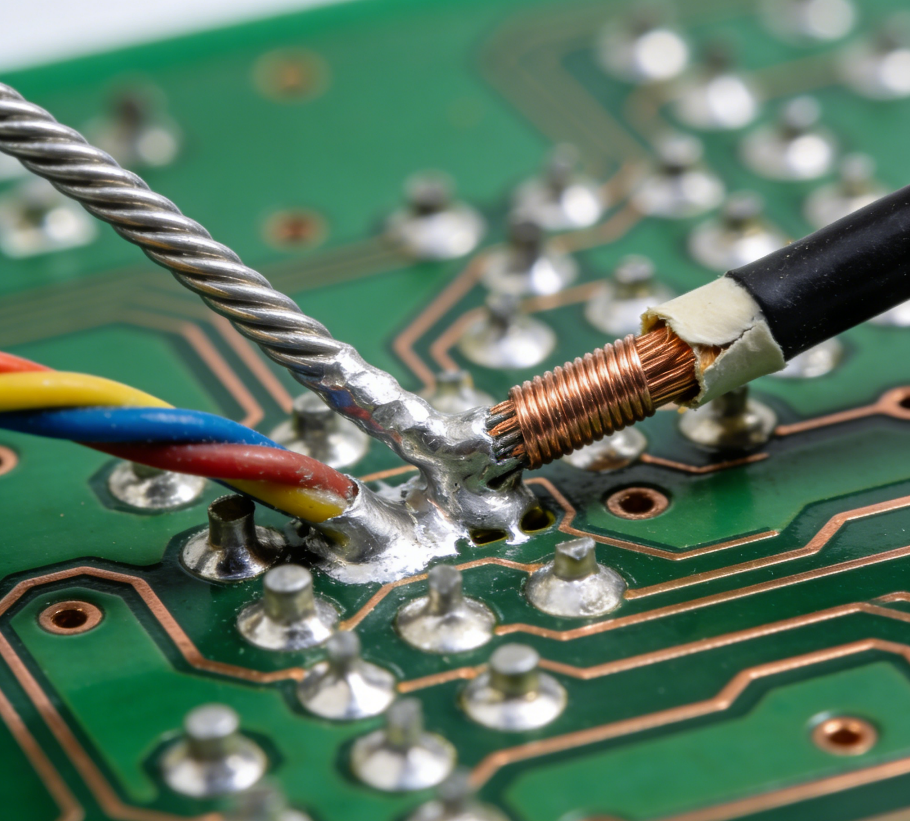
Modern stabilised power supply designs use 6-10 layer PCBs with buried thermal vias and copper core structures. These constructions create complex CTE gradients that accelerate solder joint fatigue during thermal cycling. Through-hole components experience less stress than surface-mount devices because lead compliance absorbs expansion mismatch. Ball grid array (BGA) packages — increasingly common in digital control sections of ac and dc power supply designs — accumulate fatigue damage invisible to electrical testing until catastrophic failure occurs.
Field data from North American utility-scale solar inverters shows BGA solder joint failures concentrate in corner balls experiencing maximum shear stress. Thermal cycling from -20°C to +70°C ambient (corresponding to -10°C to +95°C board temperature with self-heating) creates measurable resistance increases after 300-400 cycles, with complete electrical opens occurring at 800-1200 cycles. This correlates with 4-6 year field exposure in central US installations.
Design Modifications That Survive Extended Thermal Cycling
Practical thermal management improvements focus on three areas: component derating, thermal path optimization, and material selection. Each requires trade-offs between cost, size, and performance that depend on application-specific reliability requirements.
Component Derating Beyond Datasheet Recommendations
Standard derating guidelines — typically 80% of maximum voltage and 70% of maximum current — assume steady-state operation. Thermal cycling environments require more aggressive derating because peak stress occurs during transitions, not steady-state. A dc power source designed with 60% current derating and 70% voltage derating shows 5-10x improvement in thermal cycling MTBF compared to standard 70/80 designs.
Semiconductor junction temperature derating deserves particular attention. A MOSFET rated for 150°C junction temperature should operate below 100°C peak during thermal cycling applications, not the typical 125°C steady-state limit. This 25°C additional margin accounts for localized hot spots from current crowding and bond wire resistance that thermal models often underestimate. The cost impact is modest — typically 10-15% BOM increase from larger die sizes — but reliability improvement exceeds 300% in accelerated testing.
Thermal Interface Material Selection for Cycling Applications
Thermal interface materials (TIMs) between semiconductors and heat sinks degrade during thermal cycling through two mechanisms: bond-line pump-out and interfacial delamination. Silicone-based thermal pads exhibit superior cycling reliability compared to thermal greases, maintaining >85% of initial thermal conductivity after 1000 cycles. Phase-change materials offer even better performance but require careful application process control to avoid voids.
A frequent oversight: TIM degradation compounds with altitude. At 2000 meters elevation, reduced air pressure accelerates volatile component evaporation from thermal greases by 40-60%. North American mountain installations and European alpine renewable energy sites require TIM specifications validated at pressure-equivalent cycling conditions, not sea-level testing.
Field Reliability Correlation: Translating Test Results to Service Life
The ultimate validation question: do thermal cycling test results predict actual field performance? Correlation analysis from 2023-2025 field returns across industrial, renewable energy, and transportation applications reveals both successes and persistent gaps in prediction accuracy.
Linear power supply designs show the strongest test-to-field correlation, with 1000-cycle test results predicting 8-12 year field MTBF within 20% accuracy. Switched-mode topologies exhibit weaker correlation (30-40% error bands) because high-frequency switching losses create thermal cycling at microsecond time scales that standard tests do not capture. This explains why some redundant power supply systems pass qualification testing but experience premature failures in high-vibration or load-transient applications.
What most guides miss: electrical stress and thermal stress interact non-linearly. A stabilised power supply experiencing both thermal cycling and input voltage transients fails 2-3x faster than either stress alone would predict. Combined stress testing — thermal cycling with simultaneous voltage surge injection — provides significantly better field correlation for utility power and automotive applications where both stresses occur simultaneously.
Practical Failure Rate Estimation Methods
Engineers can estimate field failure rates using modified Arrhenius models that account for cycling effects. The Coffin-Manson relationship predicts solder joint fatigue life based on temperature range and cycle count. For stabilised power supply designs, combining Coffin-Manson solder joint predictions with capacitor electrolyte loss models and semiconductor junction stress calculations yields field MTBF estimates accurate within 35% — acceptable for warranty cost modeling and spare parts planning.
Technology purchasers should request failure rate calculations using MIL-HDBK-217 or IEC TR 62380 methods with thermal cycling adjustments. A competent vendor provides three failure rate estimates: best-case (steady-state operation, controlled environment), typical-case (moderate thermal cycling, normal environmental stress), and worst-case (maximum rated thermal cycling, combined electrical and environmental stress). The ratio between best and worst-case estimates reveals design robustness to application variation.