
How to Reset TPMS Without a Tool: Step-by-Step Guide
If a customer asks how to reset TPMS without a tool, your job at the counter is to quickly separate simple, no‑tool wins from issues that need a TPMS scan tool or a shop referral. This step‑by‑step flow is written for auto parts retailers and ecommerce support teams. It prioritizes safety, follows U.S. guidelines for tire pressure monitoring, and sets clear escalation points. For context, the U.S. standard requires a warning when any tire drops to about 25% below placard cold pressure, and that detection can take a short driving period under test conditions, as explained by NHTSA in its FMVSS No. 138 interpretation (2009) in the agency’s official record; see the regulatory Q&A in the agency’s archive under “TPMS 4 Questions” for details: NHTSA FMVSS 138 interpretation. Independent testing also shows modern systems are generally accurate but vary by model, according to the AAA 2023 TPMS study.
Note: Never advise bypassing or disabling TPMS. If a malfunction persists, recommend professional diagnosis.
The 60‑second counter triage
Start with three quick checks you can talk the customer through before any reset. First, confirm cold pressures against the driver‑door placard. “Cold” means the vehicle has been parked for at least three hours and not driven more than a mile; that’s the baseline the system expects, per NHTSA’s TireWise guidance. Second, consider temperature: pressures typically change about 1 psi for every 10°F ambient swing, which can toggle the light on a chilly morning. Third, ask about a compact spare or mismatched tire sizes; these can confuse systems—especially indirect types that compare wheel speeds—until corrected and reinitialized. If a tire won’t hold pressure or a valve leaks, refer the customer to a tire shop before continuing.
Identify the system type
Here’s the fork in the road. Direct TPMS uses pressure sensors in the wheels; it often shows per‑tire PSI on the cluster and usually has metal clamp‑in valve stems. Indirect TPMS infers pressure via ABS wheel‑speed data; it typically shows only a generic warning icon and relies on a calibration procedure after tire service. Expect different no‑tool behaviors: indirect systems need an “initialize/calibrate” step plus a drive cycle, while some direct systems will self‑clear after pressures are corrected and the vehicle is driven.
Reset TPMS without a tool on indirect systems
On indirect systems, the no‑tool path is to set correct cold pressures, then use the vehicle’s initialize or calibrate function and complete a steady drive. Many models offer a menu path in the cluster or infotainment, or a dash button labeled “SET” or with a tire icon. One widely documented example: recent Honda models provide a Calibration option in Vehicle Settings; after setting pressures to the placard, you select Calibrate and then drive at normal speeds until the system relearns. Honda documentation indicates a cumulative drive on the order of about 30 minutes at roughly 30–60 mph for calibration to complete, though specifics vary by model;
Verification after action: after calibration and a normal drive, the warning should remain off. If the light returns quickly or will not clear, confirm pressures again and recheck for a compact spare or mismatched sizes. If everything checks out and the light persists, treat it as a malfunction and escalate.
Reset TPMS without a tool on direct systems
With direct TPMS, your best no‑tool move is to normalize cold pressures to the door placard, then advise an auto‑learn drive. Many vehicles will clear a steady under‑inflation warning after 10–20 minutes of steady driving at 25–50 mph. If the customer recently rotated tires, some models that show per‑corner PSI expect a position relearn. Certain vehicles can relearn positions automatically after driving; others require a tool‑assisted stationary or OBD relearn. Tire Rack’s technical notes emphasize that the relearn method varies widely by make and model and that owners should follow vehicle‑specific instructions.
Verification after action: if pressures are correct and the vehicle completes a reasonable drive cycle, a steady TPMS light should extinguish on auto‑learn systems. If it stays on, capture more history: recent rotation or sensor replacement, intermittent readings, or any tire that won’t hold PSI. Persistent warnings after a correct drive point to a required relearn or a sensor issue.
What the light is telling you
A steady TPMS light usually means the system believes at least one tire is underinflated relative to the placard baseline—check and correct pressures first. A flashing TPMS light that blinks for roughly a minute at startup and then stays on indicates a malfunction: the system couldn’t validate sensor IDs, communication, or similar. That’s an escalation point. NHTSA’s driver guidance on TireWise covers the basics of what warning lamps signify and why drivers should verify pressures rather than rely on the lamp alone; see the agency’s education page for additional background in the same context as the regulation cited earlier.
Common blockers and how to clear them
Temperature swings can drop pressures enough overnight to trigger the warning; adjust to placard PSI when cold and drive. A compact spare or mismatched tire size prevents proper calibration on systems that compare wheel speeds; fit the correct tire and reinitialize. Corrosion at the valve stem, a loose core, or bead leaks can make the light reappear soon after a fill; direct the customer to a tire shop if pressure won’t hold. Sensor age matters too—internal batteries eventually run low, and intermittent readings or a flashing lamp after startup can be clues to failing sensors. When in doubt, recommend a shop with a TPMS tool to read sensor IDs and battery status.
When a TPMS tool is required
There are three families of relearn procedures. Auto relearn needs no tool; the vehicle learns IDs through normal driving once pressures are correct. Stationary relearn uses a TPMS trigger tool at each wheel to wake sensors while the vehicle is in learn mode. OBD relearn requires a scan tool to upload sensor IDs to the ECU. Trade sources consistently note that many models—especially on some brands—expect stationary or OBD relearns. For an industry overview of relearn fundamentals and brand patterns, see Tire Review’s explainer: TPMS relearn procedure fundamentals.
How to explain it to customers: “Your vehicle may not clear with a drive alone. Some models require a brief procedure with a TPMS tool to teach the car the sensor IDs or positions. We can refer you to a shop that performs stationary or OBD relearns so the light stays off.” For additional trade context on causes and cures, Tire Review summarizes practical remedies for common complaints in its overview of typical shop fixes: three common cures for TPMS complaints.
Quick resources for your counter team
Use these two assets to keep conversations consistent. The first is a simple decision flow. The second is a printable checklist you can keep at the counter for notes.
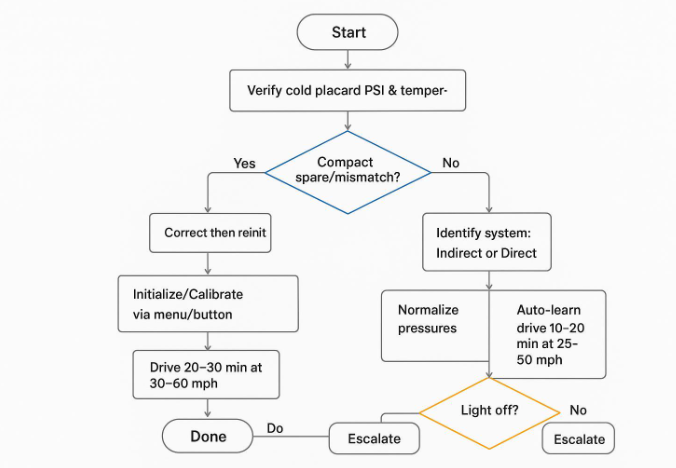
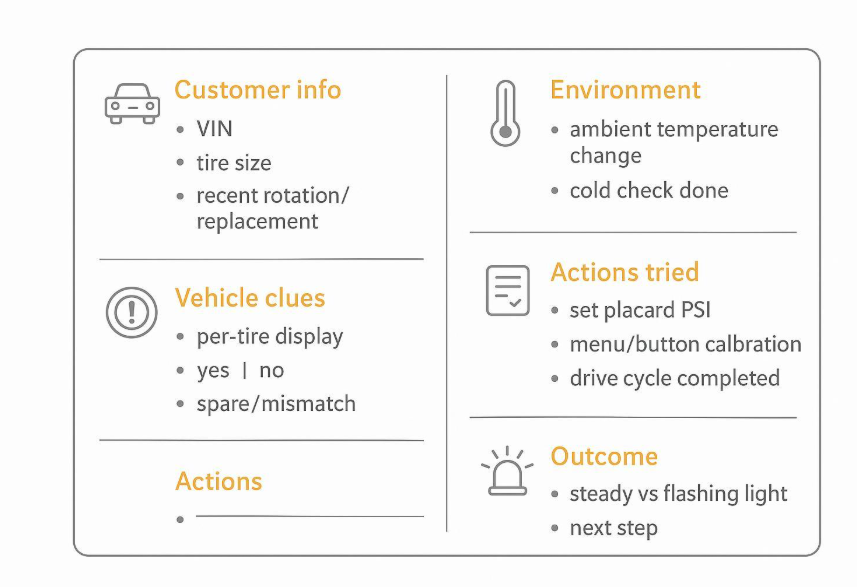
Copy‑ready callouts you can use on the phone or chat:
Let’s set your cold tire pressures to the door placard. If the TPMS light stays on after a 15–30 minute highway drive, we’ll try your vehicle’s reset or calibration. If it still won’t clear, your model may require a TPMS tool to relearn sensor IDs—we can point you to a shop that can do that.
A flashing TPMS light usually means the system itself needs service. We recommend a diagnostic scan to check sensor IDs and battery status.
Why these steps work and where they come from
The federal compliance backdrop defines when a warning must illuminate and under what conditions; that helps set realistic expectations for “how fast” a warning clears after corrections. See the official NHTSA FMVSS 138 interpretation cited earlier.
Real‑world accuracy and timing vary by model, so we advise checking pressures with a gauge and driving a reasonable cycle—advice that aligns with the AAA 2023 TPMS study and with Consumer Reports’ guidance on cold checks and placard PSI.
Indirect vs. direct system behavior—and the impact of mismatched tires—tracks with fleet and technical explainers, such as Michelin’s overview of TPMS types.
Menu calibration and drive‑cycle expectations vary; a concrete, modern example exists in recent Honda owner documentation, linked earlier in this guide.
When resets fail, it’s often because the vehicle expects a stationary or OBD relearn after rotation, replacement, or sensor battery issues; trade sources like Tire Review provide make‑level examples and fundamentals, linked above.
Safety note and escalation advice
Don’t disable or ignore the system. If you’ve confirmed placard PSI when cold, completed the appropriate initialize or drive cycle, and the light still won’t clear—or it flashes at startup—recommend professional diagnosis with a TPMS scan tool. If the customer asks for a model‑specific sequence, direct them to the owner’s manual or an OEM owner portal for the exact procedure.