
What Is a Thermoelectric Cooler?
A thermoelectric cooler — often written as TEC or called a Peltier module — is a compact electronic component that creates a temperature difference using electricity. Apply DC current and one face of the module gets cold while the other gets hot. Reverse the current and the effect reverses too.
That might sound simple, but it's a genuinely different approach to cooling compared to everything else on the market. There is no refrigerant fluid, no compressor, no fan built in, and zero moving parts. The whole device is typically a flat ceramic sandwich, anywhere from 20 mm to 62 mm across, just a few millimeters thick.
How Does a Thermoelectric Cooler Work?
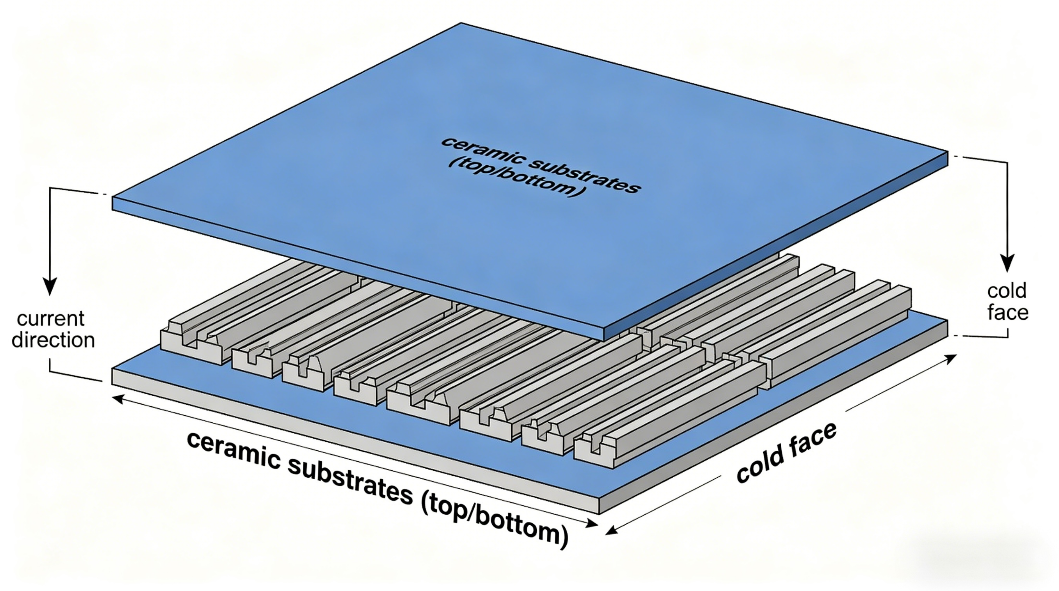
Inside a TEC module you'll find dozens of tiny semiconductor couples — pairs of n-type and p-type bismuth telluride (Bi₂Te₃) elements. They're connected electrically in series and thermally in parallel, all sandwiched between two flat ceramic substrates that you can see from the outside.
When current flows, electrons in the n-type material carry thermal energy toward the hot side. Simultaneously, "holes" in the p-type material carry energy in the same direction. The result: heat is pumped from the cold ceramic face to the hot ceramic face, consistently, as long as current is flowing.
Two numbers define how well a TEC does this job. ΔTmax is the maximum temperature difference it can create between the two faces when there is no heat load. Most standard modules reach 65–72°C. Qmax is the maximum heat it can pump when both faces are at the same temperature. Neither number reflects real-world performance on its own — you need both to size a TEC correctly for your application.
Where Are Thermoelectric Coolers Used?
TECs aren't the most efficient cooling method on paper — their Coefficient of Performance (COP) usually sits between 0.3 and 0.7. But they win in situations where efficiency is not the main constraint. Here are the most common real-world applications:
Laser diodes and fiber optic systems
Laser wavelength drifts with temperature. TEC modules mounted beneath laser packages hold junction temperature stable to within ±0.01°C — critical in telecom transceivers and spectroscopy equipment.
Medical diagnostics (PCR machines, sample coolers)
Portable PCR thermal cyclers use TEC modules to switch precisely between 95°C and 55°C. The silence and vibration-free operation matter in clinical environments where mechanical coolers would be disruptive.
Electronics cooling and CPU thermal assist
High-performance computing components use TEC modules to pull heat below ambient, keeping GPUs and processors within safe thermal margins without the bulk of liquid cooling systems.
Automotive and portable refrigeration
Car seat coolers, portable medicine storage, and 12V travel coolers all use Peltier modules. No compressor means no vibration or refrigerant handling — ideal for sealed or mobile enclosures.
Industrial temperature control and test equipment
Environmental test chambers, temperature-controlled stages, and precision sensor calibration equipment use TECs for fast, reversible, precise thermal control that mechanical systems cannot match.
How to Choose the Right TEC Module
Picking a thermoelectric cooler comes down to matching the module's specs to your real operating conditions — not just what the data sheet lists at 25°C. Here are the key parameters to pay attention to:
| Parameter | What it means | Watch out for |
|---|---|---|
| Qmax | Maximum heat the cold side can absorb when ΔT = 0 | This is a best-case figure. Real Qmax at your operating ΔT will be lower. |
| ΔTmax | Maximum temperature difference between hot and cold faces | Measured at zero heat load. With any real thermal load, ΔT drops. |
| Imax | Maximum rated current | Running at full Imax constantly degrades module life. Use 60–80% of Imax in steady operation. |
| Hot-side temp | Temperature of the face rejecting heat | Specs are at 25°C hot side. At 50°C hot side, Qmax and ΔTmax both fall significantly — often 15–25%. |
| COP | Coefficient of performance — heat pumped ÷ power consumed | Helps you size the power supply. Don't skip this calculation or you'll undersize it. |
Single-stage vs. multi-stage (cascade) TEC modules
Standard single-stage TEC modules achieve a maximum ΔT of around 65–72°C. If your application needs a larger temperature difference — for example, cooling an infrared detector to well below −40°C — you need a multi-stage cascade TEC, where two or three modules are stacked on top of each other. Each stage pumps heat out of the stage below. Cascade modules are more expensive and draw more power, so they're only used when single-stage doesn't reach far enough.
Does module size matter?
Yes — but it's not about raw size alone. The active area determines how much heat can be transferred across the ceramic faces, but what matters most is that the module footprint matches your heat source. A mismatch creates hot spots that hurt both cooling performance and long-term reliability. For precise mounting, always match the TEC's ceramic area to the component you're cooling within ±10%.
How to Source Thermoelectric Cooler Modules Reliably
TEC modules look identical on the outside. The difference between a quality module and a poor one is entirely inside — and you won't find that difference until it fails in your system.
The most common sourcing problems are batch-to-batch inconsistency in bismuth telluride purity, uneven solder joints on the ceramic substrates, and Seebeck coefficient drift across production lots. For low-volume prototyping, this might be tolerable. For production quantities, it creates unpredictable thermal performance and returns.
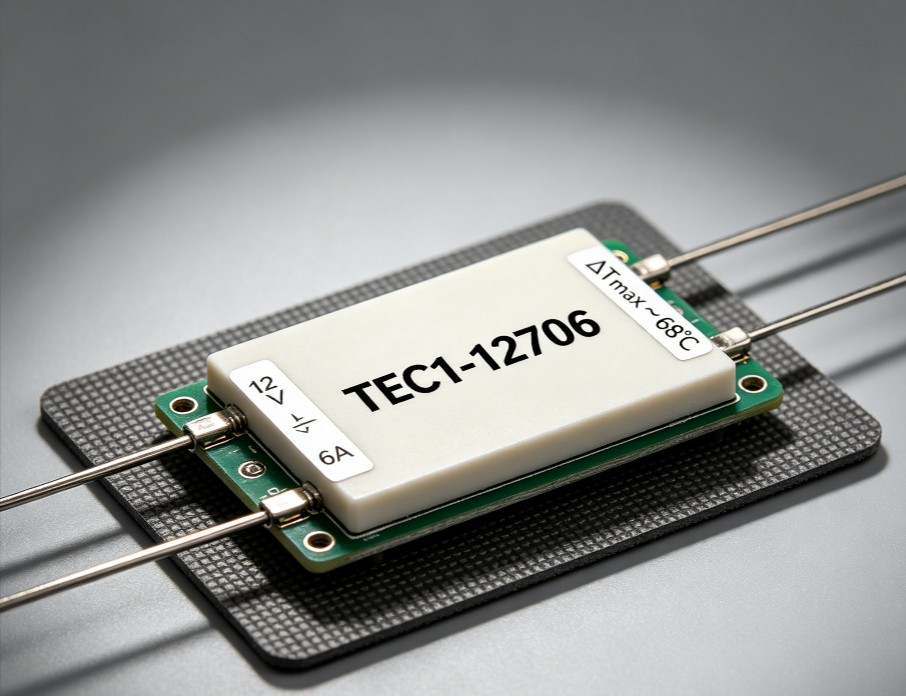
At Joydo, we carry ISO9001-certified thermoelectric cooler modules with large inventory on hand for immediate dispatch. Whether you're sourcing standard TEC1-12706 modules, custom-sized Peltier elements, or multi-stage cascade configurations, our global fulfillment network ships without the 8–16 week wait that's typical with contract manufacturers. Full traceability documentation is available on request.
If you're not sure which module fits your thermal design, our team can help you match specifications to your actual operating conditions — not just the nominal data sheet values. Visit our electronic component catalog or get in touch for a custom sourcing quote.