
AC-DC vs DC-DC Converters: Choose the Right Power Supply
Every electronics project hits the same wall at some point: the power you have isn't the power your circuit wants. Your bench supply outputs 12V. Your microcontroller wants 3.3V. Your wall outlet wall power supply pushes 120V AC. Your sensor board won't touch anything above 5V DC.
Power converters are how you bridge that gap — and picking the wrong type wastes energy, generates heat, and in some cases destroys components. This guide covers both AC-DC and DC-DC converters from a practical angle: how they work, where they're used, and how to pick the right one without overcomplicating it.
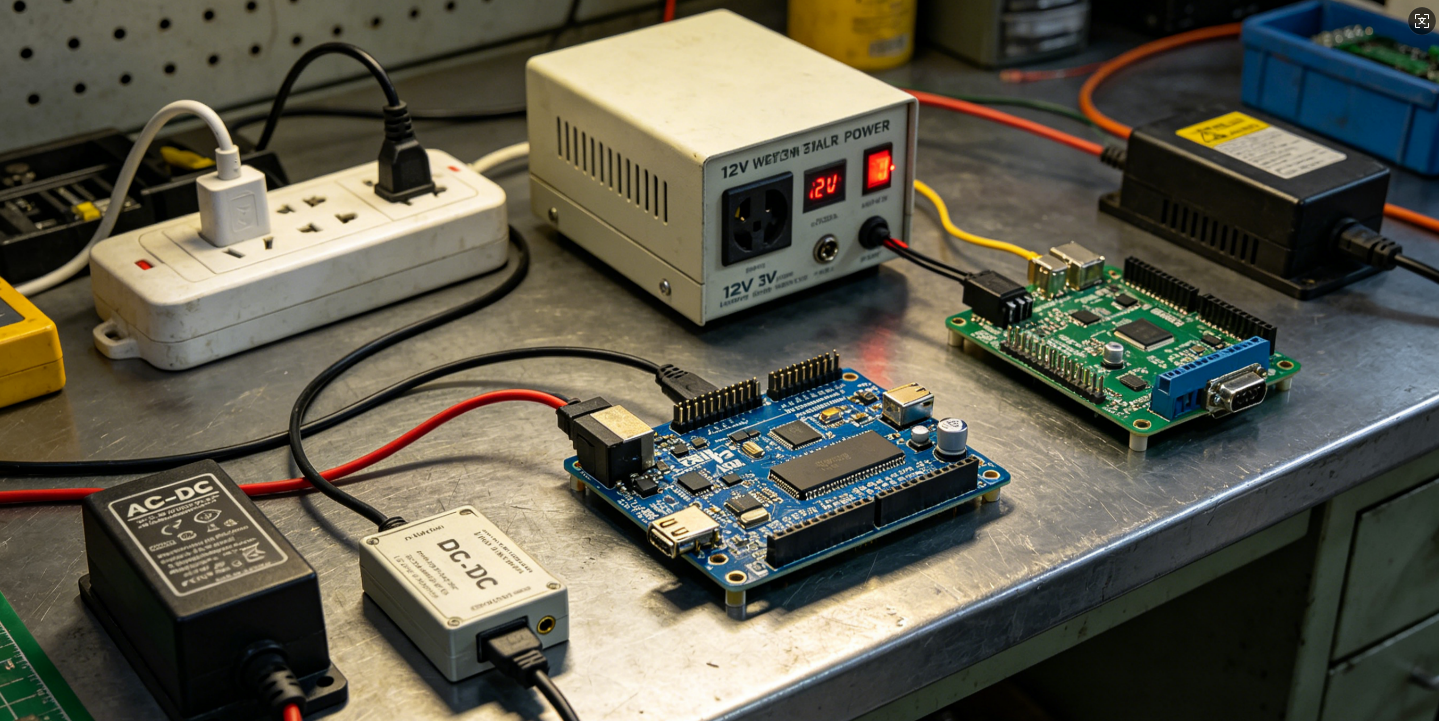
The 30-Second Primer: AC, DC, and Why Both Exist
AC (alternating current) is what comes out of your wall outlet. The voltage oscillates in a sine wave — 60 times per second in North America (60 Hz), 50 times per second in Europe (50 Hz). Power utilities use AC because transformers can step it up to hundreds of thousands of volts for long-distance transmission, then back down again near your house with very little energy loss.
DC (direct current) is what your electronics run on. Voltage holds steady at one level. Batteries output DC. Microcontrollers, LEDs, sensors, and virtually every integrated circuit require DC to operate.
The problem: the grid delivers AC, your devices need DC, and different devices need different DC voltages. That's why you need two categories of converters working together in most real systems.
AC-DC Converters: Turning Wall Power Into Something Usable
An AC-DC converter — also called a rectifier or power supply — takes the oscillating voltage from your outlet and produces a steady DC output. Nearly every device that plugs into a wall contains one, whether it's visible (a laptop brick) or hidden inside the enclosure (a desktop computer's PSU).
How AC-DC Conversion Works
The conversion happens in three stages:
1. RectificationA bridge rectifier — four diodes in a diamond configuration — flips the negative half of the AC wave upward. The result is pulsating DC: voltage that's always positive but rises and falls with each AC cycle. Full-wave rectification uses both halves of the AC cycle and is standard in modern designs. Half-wave rectification (using a single diode) throws away one half of the cycle and is rarely used outside of very simple, low-power circuits.
2. FilteringA capacitor smooths the pulses. As voltage rises, the capacitor charges. As it falls between pulses, the capacitor discharges to fill in the gap. Larger capacitance means smoother output, but also a physically larger and more expensive component — a real trade-off in compact designs.
3. RegulationA voltage regulator locks the output to a precise voltage. The classic 7805 IC, for example, accepts an input between 7V and 35V and outputs a steady 5V regardless of load current changes or input fluctuations. Modern regulators do this with under 1% variance.
The Two Main AC-DC Design Approaches
Transformer-based (linear) supplies step down the AC voltage with an iron-core transformer before rectification. They're simple to design, produce very clean output with minimal noise, and cost almost nothing at low volumes. The problem: they're heavy, bulky, and inefficient. A linear supply typically converts only 50–65% of input power into usable output — the rest becomes heat in the regulator.
Switch-mode power supplies (SMPS) work differently. Instead of burning off excess voltage as heat, a high-speed transistor switches on and off thousands of times per second . Look at ICs like the UCC28881 from Texas Instruments The duty cycle — the ratio of on-time to total cycle time — controls the output voltage. Because the transistor is either fully on or fully off rather than partially conducting, it dissipates very little power. SMPS designs routinely hit 85–95% efficiency.
The trade-off: switching circuits generate electromagnetic interference (EMI). A fast-switching transistor is a tiny radio transmitter. Cheap SMPS designs sometimes interfere with nearby FM radios or Wi-Fi. Good EMI filtering adds design complexity and cost.
When to use each:
Linear supply: audio equipment, low-noise sensor circuits, simple one-off prototypes
SMPS: anything battery-adjacent, anything with a tight heat budget, production electronics
DC-DC Converters: Reshaping Voltage Within a DC System
Once you have DC — whether from a rectified wall supply, a battery, or a solar panel — you'll almost always need to change its voltage level before connecting to specific components. DC-DC converters handle this without converting back to AC.
Buck Converters (Step-Down)
A buck converter reduces DC voltage. It uses an inductor, capacitor, and a switching transistor. The duty cycle controls the output: a transistor switching on 27.5% of the time produces 27.5% of the input voltage. Running a 12V input at that duty cycle gives you 3.3V out.
Efficiency: 88–95% in well-designed implementations.
Practical example: Powering an ESP32 microcontroller from a 12V automotive power line. A linear regulator (like the LM7833) drops the excess 8.7V as heat — at 200 mA draw, that's 1.74W of continuous heat dissipation requiring a heatsink. A buck converter like the TPS62160 handles the same conversion at ~92% efficiency, barely warming up, with no heatsink required.
Boost Converters (Step-Up)
A boost converter increases DC voltage. When the switch opens, the inductor releases its stored energy at a voltage spike higher than the input. You get more volts out than went in — at the cost of proportionally lower current, since power is conserved.
Efficiency: 85–92% typically.
Common use case: Running a 5V USB display from a 3.7V lithium cell. The MT3608 handles inputs from 2V to 24V and can boost to 28V, making it popular in small battery-powered builds.
Buck-Boost Converters
When your input voltage might be above or below your target output, a buck-boost handles both cases automatically. This matters most in battery-powered systems where voltage sags as charge depletes.
Example: A 2S lithium pack starts at 8.4V fully charged and drops to 6V near empty. If your system needs exactly 7.4V, a simple buck won't work when the battery is fresh (output too high), and a boost won't work when nearly drained. A buck-boost covers the full discharge curve.
E-bikes, portable power stations, and handheld test equipment commonly use buck-boost topologies for this reason.
Isolated DC-DC Converters
Standard buck/boost converters share a common ground between input and output. Isolated converters — flyback, forward, push-pull — use a transformer to create a magnetic link with no direct electrical path between input and output.
This matters when:
Safety requires keeping mains voltage separated from user-accessible circuits (medical devices, industrial sensors)
Two sub-circuits run at different ground potentials and need to communicate
A noisy motor controller would otherwise inject interference into a sensitive measurement circuit through a shared ground
Isolation adds cost and slightly reduces efficiency, but in safety-critical applications it's a hard requirement, not a design preference.
Efficiency in Real Numbers
Understanding efficiency lets you make concrete trade-offs rather than vague ones.
Formula: η = P_out ÷ P_in × 100%
If a converter draws 1A at 12V input (P_in = 12W) and outputs 2A at 5V (P_out = 10W), efficiency is 83.3%. The missing 1.67% = 2W is dissipated as heat.
Battery runtime comparison — 10,000 mAh cell at 3.7V (37 Wh total), powering a 1W load:
| Converter type | System efficiency | Actual draw | Runtime |
|---|---|---|---|
| Linear regulator | ~40% | 2.5W | 14.8 hrs |
| Switching converter | ~90% | 1.11W | 33.3 hrs |
Swapping one component more than doubles your runtime under identical conditions. At scale — a consumer product shipping millions of units — the efficiency difference also directly affects the electricity bill and thermal design costs.
Choosing the Right Converter: A Decision Framework
Work through these in order:
1. What's your input source?Wall outlet (AC) → you need an AC-DC converter first. Battery or existing DC rail → skip straight to DC-DC.
2. Do you need to step up or step down?Higher input than output → buck. Lower input than output → boost. Variable input that crosses your target → buck-boost.
3. Does your application require isolation?User-touching circuits, medical, or industrial safety standards → isolated converter. Pure signal-level DC systems → non-isolated is fine.
4. How much does efficiency matter?Battery-powered → efficiency is critical, use switching. Line-powered with loose heat tolerance and a noise-sensitive analog circuit → linear may be the cleaner solution.
5. What are your EMI constraints?Near RF receivers, precision analog, or certified products → budget for EMI filtering or choose a converter IC with spread-spectrum switching (look for "SSFM" in the datasheet).
Component Selection Checklist
Before committing to a specific part:
Input voltage range — Verify the converter handles your actual min/max input, not just the nominal. Automotive lines can spike to 14.4V or higher.
Output current with derating — Most converters derate at high ambient temperatures. A 3A-rated part may only deliver 2A reliably at 85°C.
Switching frequency — Higher frequency = smaller passives but more EMI. 300 kHz–1 MHz covers most general-purpose designs well.
Protection features — Overcurrent protection (OCP), overvoltage protection (OVP), and thermal shutdown aren't optional in production hardware.
Certifications — US products often need UL/FCC compliance. Medical or industrial applications add IEC 62368 or IEC 60601 requirements. Factor this into your supply chain research early.
Quick Reference
| Situation | Converter Type |
|---|---|
| Wall outlet → any DC voltage | AC-DC converter (SMPS or transformer) |
| 12V battery → 3.3V microcontroller | Buck (step-down) DC-DC |
| 3.7V cell → 5V circuit | Boost (step-up) DC-DC |
| Variable battery voltage → fixed output | Buck-boost DC-DC |
| Isolated gate driver / medical circuit | Flyback or forward isolated DC-DC |
The converter type sets the ceiling for what's possible — efficiency, heat, and size all flow from that choice. Get the topology right first, then optimize the implementation.